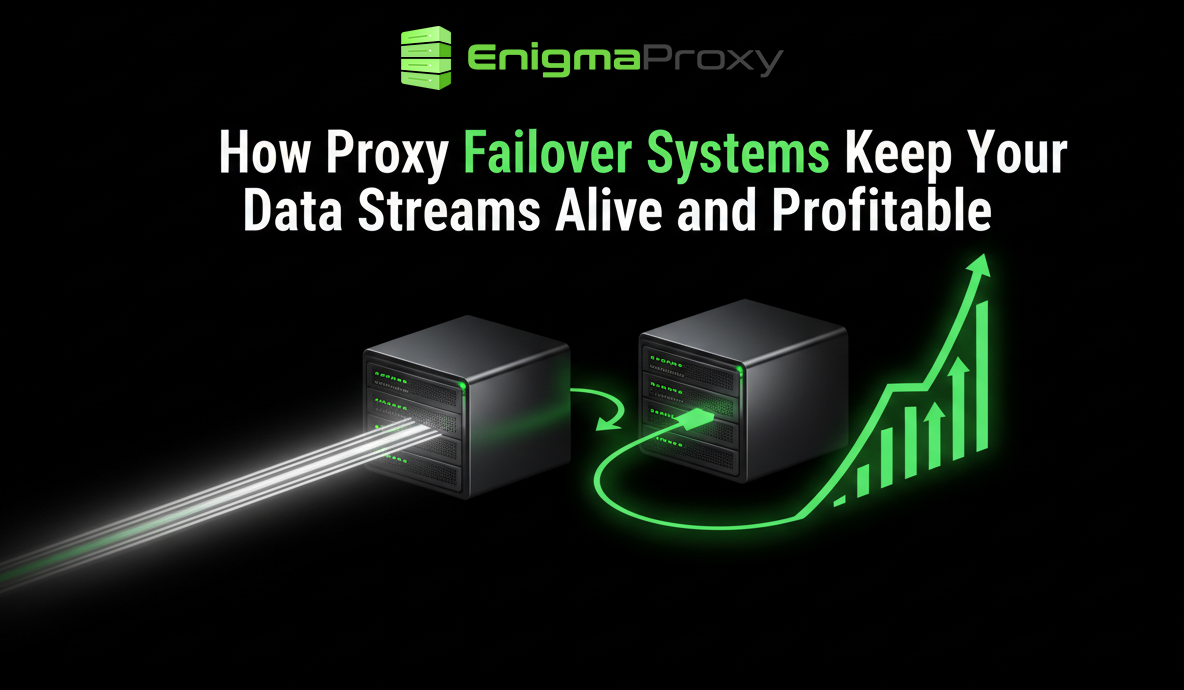
How Proxy Failover Systems Keep Your Data Streams Alive and Profitable
In the world of automated data collection, uptime is currency. Whether you are scraping e-commerce pricing, monitoring travel aggregators, or managing multiple social media accounts, a broken connection doesn't just mean a log error—it means lost revenue, missed insights, and operational drift.
For developers and data engineers, the challenge isn't just finding a proxy; it's maintaining the connection when things inevitably go wrong. This is where proxy failover systems move from being a "nice-to-have" feature to a critical component of profitable infrastructure.
The High Cost of Connection Failures
Data extraction is rarely a smooth, linear process. The internet is messy. Target servers experience latency, ISPs have outages, and anti-bot defenses trigger randomly. When a proxy connection fails without a backup plan, the ripple effects are immediate:
- Incomplete Datasets: A scraper that dies halfway through a job leaves you with gaps in your data, making analytics unreliable.
- Operational Bottlenecks: Manual intervention to restart scripts or switch IP pools kills productivity.
- Detection Risks: Aggressively retrying a request through a struggling IP often signals "bot behavior" to the target site, leading to permanent bans.
A robust failover system is the safety net that catches these errors before they crash your application, ensuring your data streams remain continuous and profitable.
What is a Proxy Failover System?
At its core, a failover system is automated redundancy. It is a logic layer that sits between your request and the target server. Instead of a request simply failing when an IP becomes unresponsive or blocked, the system automatically reroutes the traffic through a healthy alternative.
This happens in milliseconds, often transparently to the user. The goal is to decouple the success of your data operation from the stability of any single IP address.
The Anatomy of Reliability Architecture
Building a resilient proxy infrastructure involves more than just having a list of backup IPs. It requires intelligent architecture that anticipates failure before it happens.
1. Health Checks and Latency Monitoring
A premium proxy network constantly "pulses" its pools. It checks for response times (latency) and success rates. If a specific node or subnet starts showing high latency or timeout errors, the system automatically deprioritizes or removes it from the rotation before it can ruin a user's request.
2. Intelligent Auto-Rotation
In a static setup, you might use one IP until it burns out. In a failover-enabled environment, rotation is proactive. If a specific residential IP goes offline (common, as these are real user devices), the system instantly spins up a fresh IP from the same geo-location to complete the request.
3. Cascading Pool Logic
This is the "waterfall" method of reliability. If a request fails using a specific carrier-targeted pool (e.g., Verizon mobile IPs), the system can be configured to cascade down to a broader residential pool, and finally to a datacenter pool if speed is the only priority. This ensures that the data is retrieved, no matter what.
How EnigmaProxy Ensures Continuity
For businesses operating at scale, building internal failover logic is resource-intensive. It requires constant maintenance and sophisticated load balancing. This is why relying on a provider with built-in architectural resilience is a strategic advantage.
EnigmaProxy is engineered with uptime as a primary metric. By managing multiple distinct proxy pools, the infrastructure allows for seamless transitions between resources. If a specific subnet encounters friction, traffic can be intelligently routed to a different, healthy pool without the user needing to rewrite their code. This "self-healing" capability is what separates business-grade solutions from standard proxy lists.
Whether you are running high-frequency trading algorithms or slow-and-steady SEO audits, EnigmaProxy’s backend handles the complexity of connection stability so your team can focus on data analysis.
Best Practices for Implementing Failover
To truly safeguard your data streams, your internal logic should complement your provider’s capabilities:
- Implement Exponential Backoff: When a request fails, don't retry instantly. Wait, then retry. Wait longer, then retry again. This mimics human behavior and reduces strain on the proxy network.
- Error Code Segmentation: Treat a
404 Not Founddifferently than a403 Forbidden. A 403 usually requires a proxy rotation (failover), whereas a 404 might just mean the page doesn't exist. - Diversify Your IP Types: Don't rely on a single type of proxy. Mix residential and mobile IPs to ensure you have fallback options if one specific network type faces a regional outage.
The Future of Resilient Data Pipelines
As websites become more dynamic and anti-bot systems more advanced, the "retry" button will become obsolete. The future belongs to "smart" proxies—autonomous agents that understand context.
We are moving toward systems where the proxy provider doesn't just route traffic but actively analyzes the success of the request. If a specific e-commerce site blocks a certain ASN, the network will learn and automatically route future requests for that site through a different, compatible ASN. Reliability will shift from a reactive failover process to a predictive one.
Conclusion
Downtime is the enemy of data profitability. In a competitive digital landscape, you cannot afford to have your scrapers stalled by a bad connection or a banned IP.
A proxy failover system is not just insurance; it is the engine that keeps your operations running smoothly 24/7. By understanding the architecture of reliability and partnering with a provider like EnigmaProxy that prioritizes infrastructure stability, you ensure that your data pipeline is as resilient as it is powerful.
Keep your streams alive, keep your data flowing, and let the infrastructure handle the rest.